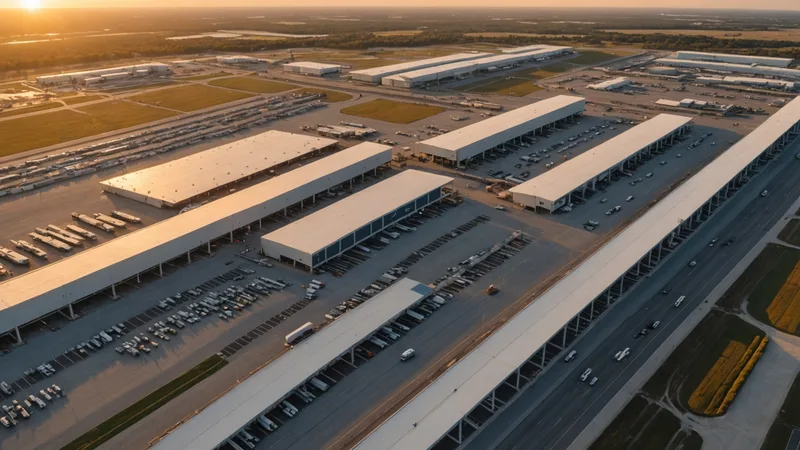
Dallas-Fort Worth doesn't usually come up first when people talk about logistics innovation hubs. That conversation tends to start with Memphis, Louisville, or the Inland Empire. But those cities earned their reputation primarily through hub-and-spoke air freight and large-format cross-dock infrastructure. Last-mile — the final segment from regional distribution center to door — is a different problem, and DFW is where that problem gets stress-tested at unusual scale.
We built Parcelarc in Dallas because the problems we were trying to solve were here, in high density, every day. This article is about what makes the DFW logistics environment specific — and why those specifics accelerate operational learning for last-mile software.
The Freight Volume Context
DFW International Airport is the third-busiest cargo airport in the United States by freight tonnage, handling over 900,000 metric tons annually. Fort Worth Alliance Airport, a dedicated cargo facility operated as a commercial airport, handles a significant share of express and e-commerce freight flowing into and out of the region. Combined, the two airports concentrate inbound freight that feeds a distribution network covering roughly 25 million people within a two-day ground radius.
The ground-side consequence of that air volume is a dense concentration of regional distribution centers — consumer goods, electronics, apparel, pharmaceutical — positioned along the I-20/I-30/I-35 triangle and along the Highway 121 corridor between Grapevine and Allen. That concentration creates a specific type of last-mile demand: high stop density in suburban residential areas, large commercial delivery clusters around business parks in Plano, Irving, and Las Colinas, and a heterogeneous mix of delivery types (B2C residential, B2B commercial, healthcare, food service) running simultaneously out of the same carrier depots.
Carriers operating regional parcel networks in DFW typically run 40–80 routes per day out of 2–5 depots, with stop densities that range from 18–24 stops per route-hour in suburban Frisco and McKinney to 35–45 stops per route-hour in denser inner-city zones like East Dallas and South Fort Worth. That range creates a fleet composition challenge: the route structure that works in Plano doesn't work in Oak Cliff.
Why DFW Specifically Tests Last-Mile Re-Optimization
Three structural features of the DFW last-mile environment make it a particularly demanding testbed for re-optimization tooling.
Late correction volume is high. E-commerce accounts in the DFW distribution corridor serve customers across Texas, Oklahoma, Louisiana, and Arkansas — a broad geography with high same-day and next-day delivery expectations. The high volume of orders per depot generates a correspondingly high volume of address corrections, customer-requested delivery changes, and business-closure exceptions. Regional carriers in this market regularly absorb 5–8% late-change rates in the 6 p.m. window on peak days.
Infrastructure variability is extreme. DFW encompasses highly planned suburban grid development (Frisco, Allen, Prosper) and irregular older street networks (parts of Fort Worth, Grand Prairie, Mesquite). A route that's straightforward in one zone becomes a dwell-time trap in another. Gated communities, apartment complexes requiring building entry codes, and industrial park access restrictions add a layer of non-geographic constraint that a distance-optimized sequence doesn't capture without local knowledge baked into the solver.
HOS window pressure is real. Texas summer heat creates driver fatigue patterns that push against electronic logging device (ELD) compliance under 49 CFR 395. Carriers operating through summer with afternoon departure windows find their drivers closer to hours-of-service limits by late route completion. A sequence that looked fine at 3 p.m. planning time may have a driver in a compliance-risk window by 7:30 p.m. if the route ran long due to access delays. Re-optimization that incorporates current HOS position — not just planned hours — is operationally relevant in this environment in a way that's less acute in moderate-climate markets.
The Carrier Community Building Here
DFW hosts a disproportionate concentration of regional parcel carriers relative to its population. This isn't surprising given the freight infrastructure, but it has a less-obvious effect: there's a dense peer community of operations directors, dispatch managers, and logistics engineers who talk to each other, share operational problems, and collectively develop operational intelligence about the market's specific constraints.
That community is where the most practical last-mile knowledge accumulates. When a carrier figures out that scheduling gated-community residential stops in the 2–4 p.m. window reduces failed first attempts by 18–22% in certain zip codes, that insight doesn't stay siloed for long. When a dispatch manager figures out a better exception-handling protocol for apartment complexes, the pattern propagates through informal networks.
Carrier operations in DFW have been early adopters of GPS fleet telematics (Samsara and Verizon Connect are both well-represented), ELD compliance tooling, and driver communication platforms. The market's operational maturity — not its hype — is what makes it a useful incubator for new tooling. When you're working with an ops director who has run 300 routes a day for seven years in this specific market, the feedback on what's useful versus what sounds good in a demo is direct and specific.
What This Means for Software Built Here
Building last-mile optimization software in DFW means the operational edge cases are present in your development context. Constraint scenarios that might be theoretical for a tool built in a lower-density or less-variable market are live operational problems that carriers in this market face weekly.
The apartment-complex access code problem. The business-park delivery cutoff at 5 p.m. that a route sequence overruns. The driver substitution at 5:45 p.m. when the scheduled driver calls out. The e-commerce client correction batch that arrives at 6:50 p.m. for a 7:10 p.m. depot departure. These aren't theoretical edge cases — they're the normal operating environment for mid-sized regional carriers in this market.
We're not saying DFW is harder than every other metro in last-mile logistics. Chicago, LA, and the Mid-Atlantic corridor all have their own constraint profiles. We're saying that DFW's combination of freight density, infrastructure variability, and operational peer community creates a development environment where tools either handle the hard cases or they don't get adopted.
The carrier operations page covers the specific constraint types Parcelarc was designed to handle in this market context. The re-optimization engine overview goes into the technical architecture behind the 30-second re-sequence target that DFW's pre-departure window demands.